
Understanding your bill
Why Is My Electricity Delivery Charge Higher Than My Supply Charge?
The short answer
Delivery can exceed supply because it combines network charges, fixed customer costs and other applicable items, while supply prices may be lower. Some delivery charges depend on kWh and others do not. Check the exact line items and service dates; a larger delivery subtotal alone does not prove an error. A supplier switch generally changes eligible supply costs, not the local delivery network.
A bill can show a larger charge for delivering electricity than for buying the electricity itself. That comparison alone does not tell you whether the bill is correct. The useful question is which charges produced each subtotal, and whether the right rates and usage were applied to your account.
This guide helps you check that calculation. It focuses on ordinary household bills that separate supply from delivery or other non-supply charges. Your utility may group the same kinds of costs differently. All dollar examples below are invented for explanation, not current utility rates or supplier offers.
First, compare the same billing period
Find the detailed charges for current electric service, rather than starting with the amount due. Write down the service dates, billing days, electricity used in kilowatt-hours (kWh), supply subtotal, and each remaining current-service subtotal. Keep an old balance, late fee, deposit, payment, or budget-billing adjustment outside this comparison. Those items can affect what you owe without changing the price of this month's electricity.
If a supplier sends a separate bill, use both documents for the same service period. Otherwise, a comparison can accidentally omit supply or count it twice. If the usage or service dates do not match, ask each company to explain the difference before combining the amounts. For a broader investigation of a sudden increase, use our high electric bill checklist.
What the main charges mean
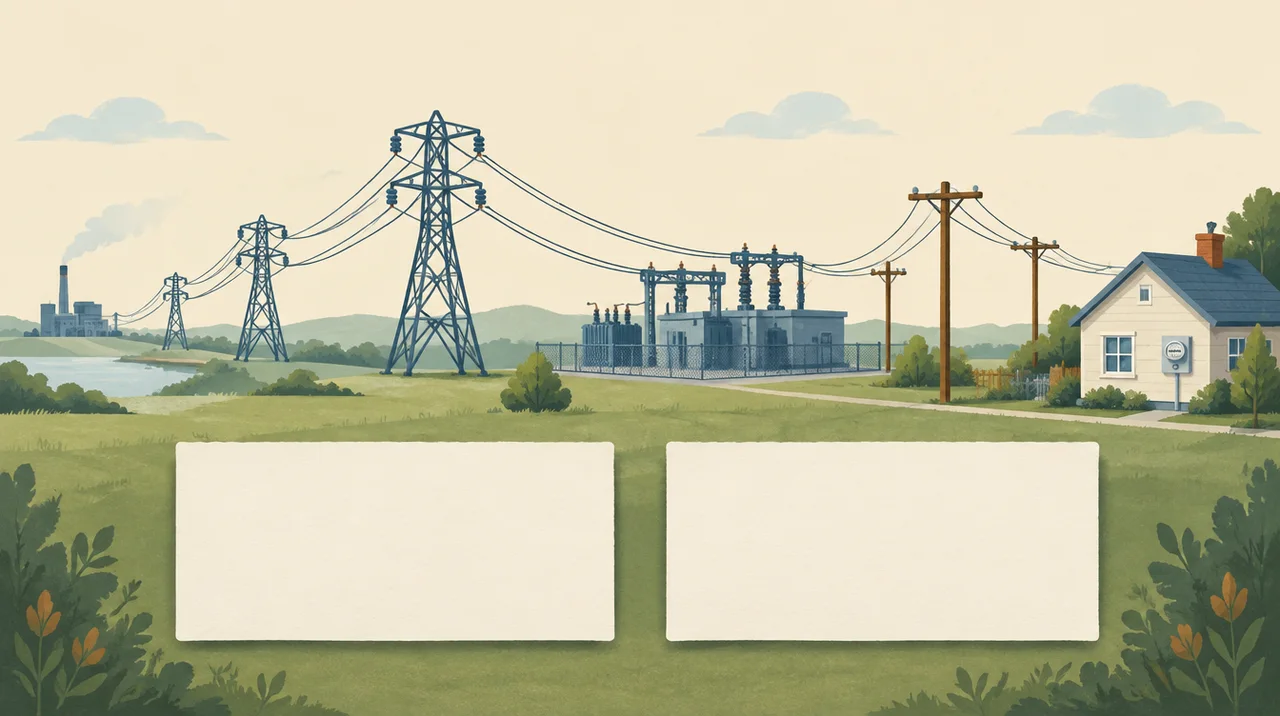
Supply generally pays for the electrical energy purchased for your use. Delivery covers the network and services that get it to your premises. A bill may also show public programs and adjustments, either inside a delivery subtotal or in separate sections. Here is a reading aid, not a list of charges every household pays.
| Bill label | What it generally represents | What to check |
|---|---|---|
| Supply or generation | The electricity purchased for your account | Supplier name, price, applicable kWh and contract terms |
| Transmission | The regional high-voltage network | Whether it is a separate line or included in another subtotal |
| Distribution or local delivery | The local network serving customers | Per-kWh rates and any included adjustments |
| Customer or fixed monthly charge | Account and service costs | Whether it is a fixed charge for the billing period |
| Public benefits, riders or adjustments | Specified programs or cost reconciliations | The tariff definition, effective dates, and whether the amount is a charge or credit |
The Massachusetts Department of Public Utilities' bill guide explains that distribution pricing includes both a monthly customer charge and a usage-based rate. It also identifies costs folded into the distribution rate that may not appear as individual lines. A short bill is therefore not necessarily a simple tariff.
Eversource's explanation of delivery charges distinguishes fixed customer-service costs from charges affected by consumption. Do not assume that everything under “delivery” is a flat fee, or that every listed component applies in each Eversource service territory.
Why delivery can be the larger amount
There are several different ways to arrive at that result:
- You are comparing one energy price with several other charges. Distribution, transmission, fixed charges and program costs can add up to more than the supply subtotal.
- The supply price fell. Delivery can become a larger share of a smaller total bill, even if no delivery rate increased.
- A fixed charge is spread over fewer kWh. At low usage, the customer charge weighs more heavily in the bill's average cost per kWh.
- One or more rates changed. Check the actual line items and effective dates instead of treating a changed subtotal as proof of a changed rate.
The U.S. Energy Information Administration describes electricity prices as reflecting both generation and network costs, including construction, financing, operations and maintenance. Those costs do not all change together. That explains why the components can move differently; it does not verify any particular customer's bill.
A worked example: $60 for supply, $93 for everything else
Suppose a household uses 600 kWh in one billing period under the following simplified flat-rate arrangement. We group the remaining charges as “delivery and other non-supply charges” for this exercise. Your bill may put public programs in a separate section.
| Item | Calculation | Amount |
|---|---|---|
| Supply | 600 kWh × $0.10/kWh | $60.00 |
| Local distribution | 600 kWh × $0.075/kWh | $45.00 |
| Transmission | 600 kWh × $0.04/kWh | $24.00 |
| Programs and adjustments | 600 kWh × $0.02/kWh | $12.00 |
| Fixed customer charge | One charge per period | $12.00 |
| Delivery and other non-supply subtotal | $45 + $24 + $12 + $12 | $93.00 |
| Current-service total | $60 supply + $93 remaining charges | $153.00 |
Example limits: there are no taxes, discounts, credits, supplier fees, demand charges, time-of-use prices, previous balances or payment-plan adjustments in this model. The subtotal row is a summary, not an additional charge. The assumed rates do not describe any named utility.
The $93 subtotal exceeds $60 because it combines four items. It is not a second purchase of 600 kWh. The same measured usage is used to calculate several different services. To check your own bill, reproduce each line's multiplication and then add the lines once.
What if consumption falls by half?
At 300 kWh, with exactly the same rates and fixed charge, supply becomes $30. Distribution is $22.50, transmission is $12, programs are $6, and the customer charge remains $12. The non-supply subtotal is $52.50 and the total is $82.50.
The bill falls by $70.50, but not by a full 50%, because the $12 fixed charge remains. Meanwhile, the average total price rises from 25.5 cents per kWh ($153 ÷ 600) to 27.5 cents ($82.50 ÷ 300). None of the assumed rates increased. This is why dividing the total bill by usage is useful for budgeting but cannot, by itself, identify a tariff increase.
What if only the supply price falls?
Return to 600 kWh. A supply price of $0.08/kWh instead of $0.10/kWh makes supply $48. Keep the same $93 of other charges, and the bill becomes $141. The supply price is 20% lower, but the whole bill falls by $12, or about 7.8%.
Delivery and other charges now represent about 66% of the bill, compared with about 61% before. That larger percentage accompanies a lower total. If the new supplier also adds a $6 monthly fee, the modeled bill is $147 and the saving is only $6. Always include fees before accepting an advertised percentage saving.
Will changing suppliers remove delivery charges?
In areas with separate retail supply choice, changing the energy seller does not generally replace the local delivery utility. For example, Connecticut's Office of Consumer Counsel explains that Eversource or United Illuminating continues delivering electricity when a customer chooses another retail supplier. It describes four bill sections: supply, transmission, local delivery and public benefits. Avoid combining some of those into “delivery” in one month and using only local delivery in another.
Connecticut also distinguishes bypassable charges from non-bypassable charges. Ask which exact charges would change for your account; “switching affects supply” is a useful starting point, not permission to ignore tariff details. The OCC page contains current and historical rate information. Use the document covering your service dates rather than copying a number from an old bill or search result.
In Pennsylvania, the regulator's PAPowerSwitch FAQ explains the Price to Compare as a benchmark for the generation portion of the bill. Comparing a supplier's generation-only offer with your total bill divided by kWh mixes different costs. Our energy-offer comparison guide shows how to compare equivalent charges and contract terms.
Texas requires its own comparison. Reliant's explanation of delivery charges says the transmission and distribution service provider's charges for the premises do not change simply because the customer selects a different retail provider. It also describes an average price that combines retail and delivery charges. Check the plan's Electricity Facts Label before adding delivery yourself; otherwise, you may count a cost twice. Do not assume a Texas advertised average price is a supply-only quote.
Supplier choice is not available for every account in every state. Start with the official resources in our state energy guide directory, then check your utility territory and customer class.
Check your bill in five steps
- Record the billing inputs. Note the meter identifier, service dates, billed kWh, and whether readings are actual or estimated. Save the current bill and a comparable earlier bill. A longer period can increase usage-based charges even when daily consumption is unchanged.
- Get the applicable rate document. Ask for the tariff or rate schedule matching the rate code on your account. Record its effective date. If a price changed during the billing period, ask how the company allocated usage between the old and new rates.
- Check units before calculating. A line showing 4 cents per kWh means $0.04 multiplied by kWh, not $4. A monthly charge should not be multiplied by consumption. Keep credits negative. Small rounding differences are different from an unexplained new charge.
- Match every line to its definition. Identify fixed, usage-based and adjustment items. Ask whether an apparent extra fee is already included in another displayed rate. For time-varying prices, use the relevant periods rather than one flat rate; our time-of-use guide explains that comparison.
- Reconcile the subtotal and amount due separately. Once current-service charges add up, account for previous balances, payments and adjustments. Write down the exact unexplained line and amount so the utility can investigate a specific discrepancy.
Do not edit or open the meter to test a billing theory. Ask the utility about its reading-verification process if the account information or measured consumption looks wrong.
What you can actually change
Reduce the usage-based portion. In the example above, every 100 kWh avoided reduces charges by $23.50: $10 in supply plus $13.50 across the other per-kWh items. The $12 customer charge remains. That result applies only to the assumed flat-rate model; tiered rates, conditional credits, demand pricing and time-of-use schedules need their own calculation.
Compare the eligible supply portion. Use the same usage and dates for both options, including fees and renewal terms. Do not switch solely because the delivery share looks large. A favorable supply offer may still help, but it cannot deliver a percentage reduction in the whole bill just because its energy price is lower by that percentage.
Check discounts and billing mistakes. An eligible assistance program or corrected error may change what you owe, but eligibility is account-specific. Connecticut PURA directs customers with payment difficulty to their utility or the state's assistance resources. It also says customers cannot simply opt out of the public benefits charge. See PURA's consumer FAQ; other states have different programs and rules.
A useful script for your utility call
Have the bill in front of you and ask:
“For the service period shown on this bill, my account has ___ kWh, a supply subtotal of ___, and other current-service charges totaling ___. Please identify the rate schedule for my account, explain the line called ___, and show me how its amount was calculated. Which charges are fixed, which depend on usage, and which would change if I selected another supplier?”
Record the representative's explanation, case number and promised follow-up date. Ask for the tariff link and a written explanation of any correction. If the issue remains unresolved, use our utility help page to find the appropriate official route. In Connecticut, PURA requires customers to try the utility first and warns that filing a complaint does not automatically stop a disconnection. Do not assume a complaint changes payment deadlines; ask how the amount and due date will be handled while it is reviewed.
Keep your calculation alongside the company's answer. Your goal is to establish whether the bill uses the correct rate, usage and charges, then choose an action that can change the result.
Related questions
Why does delivery still cost money when I use very little electricity?
A fixed customer charge can remain while usage-based charges shrink. In this guide’s hypothetical example, reducing usage from 600 to 300 kWh lowers the total bill from $153 to $82.50, but the $12 customer charge stays the same. Check your actual tariff; these are not utility rates.
Does a higher delivery share mean my bill got worse?
No. If supply becomes cheaper while delivery stays unchanged, delivery represents a larger share of a smaller total. Compare the actual dollars, rates and usage, not just the percentage shown in a bill chart.
Is it a duplicate charge when supply and delivery both use the same kWh?
Not by itself. The same measured consumption can determine separate charges for energy and delivery services. A duplicated bill line is a different issue: match every amount to its tariff definition and add each applicable item only once.
Can I compare a supplier quote with my whole bill divided by kWh?
Only if both figures cover the same costs and pricing conditions. A generation-only quote should not be compared directly with a whole-bill average that includes delivery and fixed fees. Check the quote’s inclusions, monthly fees and applicable usage before calculating any saving.
Official sources and further reading
- Understanding your electric bill Massachusetts Department of Public Utilities
- Delivery and Supply Charges Explained Eversource
- Prices and factors affecting prices U.S. Energy Information Administration
- Understand your electric bill Connecticut Office of Consumer Counsel
- Frequently Asked Questions Pennsylvania Public Utility Commission / PAPowerSwitch
- TDSP Changes Reliant Energy
- Frequently Asked Questions Connecticut Public Utilities Regulatory Authority
Consumer questions behind this guide
These public discussions helped identify the question. Individual accounts and comments are not verified advice. The guidance above uses official sources.
Prepared with AI assistance. This independent guide does not sell energy or enroll accounts. Read our research method. Confirm the rules for your utility, state and contract before acting.