
Efficient heating and cooling
Switching from Gas to Electric During a Remodel: What to Budget Now and What Can Wait
The short answer
Separate installation spending from future energy bills. Price the same finished scope for both a single project and a staged conversion, identify useful preparation while walls are open, and calculate operating costs with your own rates. Staging can reduce the initial payment while increasing the eventual total.
Replacing gas appliances during a remodel involves two financial decisions: how much to spend on the conversion, and how the new equipment may change your energy bills.
Start by identifying the appliances you expect to replace and the work each installation requires. Then ask which preparations are worth completing while the relevant parts of the house are accessible. A staged plan can reduce your immediate spending, but additional visits, approvals, or repairs may increase the eventual total.
The useful comparison is between clearly defined options that deliver the same finished result. This guide explains how to build that comparison, including an illustrative installation budget and an operating-cost calculation.
Sources checked October 23, 2026. California examples are identified below; permit requirements, utility procedures, and energy prices vary by location.
Start with two budgets: installation and ongoing energy costs
Your installation budget should cover everything needed to put the selected equipment into service. Depending on the project, that may include appliances, electrical work, plumbing, ventilation, removal of old equipment, permits, and repairs to finished surfaces.
Your operating budget estimates what the household will spend after the change. Electricity consumption may increase as gas consumption falls. Compare the combined effect on both bills.
Keep these questions separate:
- Can you afford the installation and any unresolved work?
- How might the conversion change annual energy spending?
- Does replacing a functioning appliance now make sense compared with replacing it later?
A lower operating cost does not establish that an early replacement pays for itself. Conversely, a project may be worthwhile for comfort, equipment condition, or cooking preferences even when bill savings are modest.
List what you plan to replace—and when
Create a short equipment list before requesting detailed proposals.
| Equipment | Current decision | Information still needed |
|---|---|---|
| Gas range | Replace during the kitchen remodel | Selected induction model and installation requirements |
| Gas water heater | Consider replacement in a later phase | Condition, suitable replacement location, and equipment choice |
| Gas furnace | Retain for now | How this affects the longer-term plan and continued gas service |
| Future electric appliance | Undecided | Whether preparation has a sufficiently clear purpose |
Mark a possible future purchase as provisional. Contractors need to distinguish equipment they must accommodate now from an idea that may change.
Ask the electrical contractor to assess the proposed loads before assuming a panel or utility service upgrade is necessary. The U.S. Department of Energy has funded research into equipment and capacity-management approaches that may avoid some upgrades. That establishes a reason to evaluate alternatives, not a guarantee that an existing service will suit a particular home. DOE: Electrification under electrical panel and service constraints.
Identify the full installation scope
An appliance price is only one part of the budget. Ask each bidder to identify what is included, excluded, or still awaiting investigation.
For a conversion involving several trades, use these categories:
| Budget category | What to clarify |
|---|---|
| Equipment | Model, delivery, applicable tax, accessories, and responsibility for purchasing |
| Electrical work | Assessment, circuits, connections, and any justified panel or service changes |
| Other installation work | Plumbing, drainage, ventilation, controls, and gas-appliance retirement where applicable |
| Access and restoration | Opening surfaces, protecting occupied rooms, patching, painting, and cleanup |
| Approvals | Permit applications, fees, inspections, and responsibility for completion |
| Unknown conditions | What needs investigation and how additional work will be priced |
California’s Contractors State License Board advises that a home-improvement contract identify the work, price, payment arrangements, permit responsibilities, and completion terms. It also advises documenting changes in writing. A proposal that leaves important work “by others” should identify who those others are before you rely on its total. CSLB: Contracts and binding agreements.
Keep the base remodel separate from the additional electrification work. For example, replacing kitchen cabinets may already be part of your project regardless of which range you choose. Charging the entire kitchen renovation to electrification would distort the comparison.
Consider useful preparation while walls are open
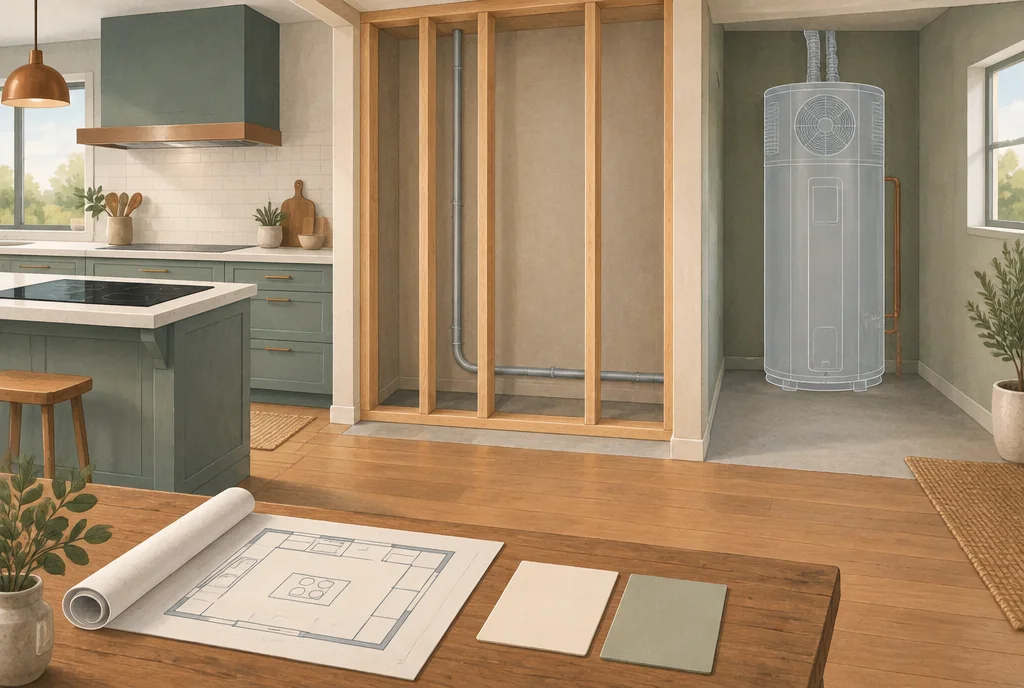
A remodel may expose a route that would be disruptive to reach later. That creates an opportunity to ask about preparation for a likely future appliance.
However, a prepared pathway, completed wiring, and an installed appliance are different deliverables. The proposal should say which one you are buying and what remains for the next phase.
If your remodel opens walls along a likely route to a future electric appliance, ask your contractor to price that preparation separately from a completed circuit. YKCA Inc (California CSLB license #1158693) explains this distinction in its guide to preparing electrical pathways for staged gas-appliance replacement. The guide covers route planning, inspection timing, and records to retain before walls close. Use it to prepare questions for your project team; a reserved pathway does not establish that your existing electrical service can support the future appliance.
Confirm inspection timing with the building department responsible for your property. For example, San Mateo specifies that under-floor work is inspected before insulation and subfloor installation, and describes separate rough and final electrical inspections. Its guidance also states that required inspections depend on the work performed. Those are local requirements, not a universal checklist for every preparation project. City of San Mateo: Building inspection FAQs.
Decide what can wait
Preparation deserves its own spending decision. Ask what future expense or disruption it is expected to avoid, and what assumptions must remain true for it to be useful.
| Decision | A useful test |
|---|---|
| Complete now | Is this required for the selected equipment or current construction phase? |
| Prepare now | Is the future use sufficiently likely, and is the preparation clearly specified? |
| Decide later | Does the work depend on equipment, timing, or locations that remain uncertain? |
Avoid purchasing an appliance simply because the walls are open. Final equipment selection may affect space, electrical requirements, and the installation scope.
Likewise, do not postpone necessary work solely to make the first proposal look smaller. A staged plan needs a workable arrangement for cooking, heating, and hot water between phases.
Compare one installation phase with a staged conversion
Consider a hypothetical household replacing its gas range during a kitchen remodel. It also intends to replace a functioning gas water heater with a heat pump water heater.
The household compares:
- Option A: Install both appliances during the remodel.
- Option B: Install the range and prepare the future route now, then replace the water heater two years later.
Both options reach the same final equipment configuration. For this example, assume the assessment finds no need for a panel or utility service upgrade.
Illustrative example · Installation budget
Every amount below is invented to demonstrate the calculation. These are not market-price estimates or contractor quotations.
On a small screen, swipe the table sideways to compare all columns.
| Illustrative cost item | Option A: now | Option B: now | Option B: two years later |
|---|---|---|---|
| Shared assessment and planning | $600 | $600 | $0 |
| Induction range and defined installation package | $4,800 | $4,800 | $0 |
| Route preparation for the water heater | $700 | $700 | $0 |
| Heat pump water heater and remaining installation work | $5,500 | $0 | $5,500 |
| Baseline permit and inspection allowance | $900 | $450 | $450 |
| Additional return visit and setup | $0 | $0 | $800 |
| Additional permit/application allowance for separate phasing | $0 | $0 | $400 |
| Total paid in each period | $12,500 | $6,550 | $7,150 |
For the illustration, equipment packages include delivery and applicable sales tax. Necessary connections, specified removal work, and associated finish repairs are assumed to be included in the relevant packages. The water-heater package excludes the route preparation shown separately.
The figures exclude the base kitchen remodel, financing, rebates, tax credits, unexpected repairs, and inflation. Later equipment prices are held constant to isolate the effect of phasing. Actual permit charges must be obtained locally; the split above is an assumption.
The arithmetic is:
Option A:
$600 + $4,800 + $700 + $5,500 + $900 = $12,500
Option B:
$6,550 now + $7,150 later = $13,700
Staging reduces the immediate outlay by $5,950, but adds $1,200 to the eventual installation cost under these assumptions.
That does not automatically make Option A the better household decision. Option B preserves cash now and allows continued use of the existing water heater. A fuller comparison would also consider financing, possible repairs, remaining equipment life, and the timing of future replacements.
The installation table alone does not account for energy costs during the two-year delay.
Estimate future bills using your own rates and expected consumption
An appliance’s EnergyGuide label can help compare models, but its dollar estimate is not a prediction of your household’s bill. The Federal Trade Commission’s Energy Labeling Rule bases these estimates on standardized testing and national average energy prices; actual costs depend on local prices and use. FTC: Energy Labeling Rule, 2026 edition (PDF).
For a useful operating estimate, gather:
- Twelve months of electricity and gas consumption, including seasonal changes.
- The rates that would apply to additional electricity and avoided gas consumption.
- Equipment-specific estimates adjusted to household use and installation conditions.
- Any fixed or minimum charges that would remain.
- Expected changes in other equipment or household routines.
A kilowatt-hour, or kWh, measures electrical energy. A therm is a unit commonly used for billed natural gas. Do not compare the price of one kWh directly with the price of one therm: the units differ, and the appliances use energy differently.
Heat pumps transfer heat rather than producing it solely through electric resistance. That affects the electricity needed to provide heating, but the technology alone does not determine whether operating costs will be lower than gas. ENERGY STAR: How heat pump water heaters work.
Illustrative example · Energy costs
A worked operating-cost example
Invented consumption and rates, not actual PG&E tariffs or measured customer results.
Continue the hypothetical water-heater comparison. Assume both appliances provide the same household hot-water service, using these illustrative annual estimates:
On a small screen, swipe the table sideways to compare all columns.
| Input | Gas water heater | Heat pump water heater |
|---|---|---|
| Annual energy consumption | 260 therms | 1,400 kWh |
| Assumed variable energy price | $2.40 per therm | $0.32 per kWh |
| Annual variable energy cost | $624 | $448 |
The prices represent hypothetical combined variable charges for energy supply and delivery. Separate taxes and surcharges are excluded. Unchanged fixed charges are excluded from both sides. Any small electrical use of the existing gas unit is assumed negligible.
Gas: 260 × $2.40 = $624 per year
Electric: 1,400 × $0.32 = $448 per year
Difference: $624 − $448 = $176 per year
In this simplified model, waiting two years to replace the water heater adds $352 in variable energy costs compared with replacing it immediately.
Combined with the illustrative installation difference:
$1,200 + $352 = $1,552 more for the staged option over the comparison period.
This is a comparison between the two assumed schedules, not a lifetime-cost analysis or proof of payback. It excludes equipment-age differences at the end of the period, maintenance, financing, and future replacement costs.
The tariff assumption also matters. At $0.48 per kWh, the same assumed electric consumption costs:
1,400 × $0.48 = $672 per year
That is $48 more than the assumed gas cost. The operating advantage reverses.
For a time-of-use tariff, estimate when the additional electricity will be consumed and apply the corresponding rates. A single annual price is only a simplifying assumption.
Do not assume the gas bill disappears
In this example, the household retains a gas furnace, so neither option receives credit for eliminating gas service charges.
Even after the last gas appliance is retired, ending utility service is a separate process. PG&E distinguishes stopping service and removing a meter from removing the gas service line. Confirm the appropriate request, any charges, and the effective date with your own utility. PG&E: Residential project resources.
Check the comparison before approving the work
Before choosing an option, make sure you can answer these questions:
- Do both proposals deliver the same intended result?
- Are equipment models selected, or are allowances clearly identified?
- Who completes each electrical, plumbing, appliance, and finish-work task?
- What preparation remains useful if a later equipment choice changes?
- Which permits and inspections belong to each phase?
- What is excluded, unresolved, or priced only provisionally?
- Does the bill estimate include both electricity and gas?
- Which savings depend on actually ending gas service?
- Are incentives confirmed, or merely assumed?
- What records will the next installer receive?
Request a written comparison of the immediate scope and any later phase. Use the same equipment assumptions and identify each extra visit, approval, or restoration task separately. That gives you a practical basis for deciding how much to commit now.
For help reviewing the energy side of the decision, see our guides to checking a high electricity bill, evaluating a time-of-use rate, and understanding supply and delivery charges.
Official sources and further reading
- Electrification under electrical panel and service constraints U.S. Department of Energy
- Contracts and binding agreements California Contractors State License Board
- Building inspection frequently asked questions City of San Mateo
- Energy Labeling Rule, 16 CFR Part 305 (2026 edition, PDF) Federal Trade Commission; official CFR edition hosted by U.S. Government Publishing Office
- How heat pump water heaters work ENERGY STAR
- Residential project resources Pacific Gas and Electric Company
Prepared with AI assistance. This independent guide does not sell energy or enroll accounts. Read our research method. Confirm the rules for your utility, state and contract before acting.